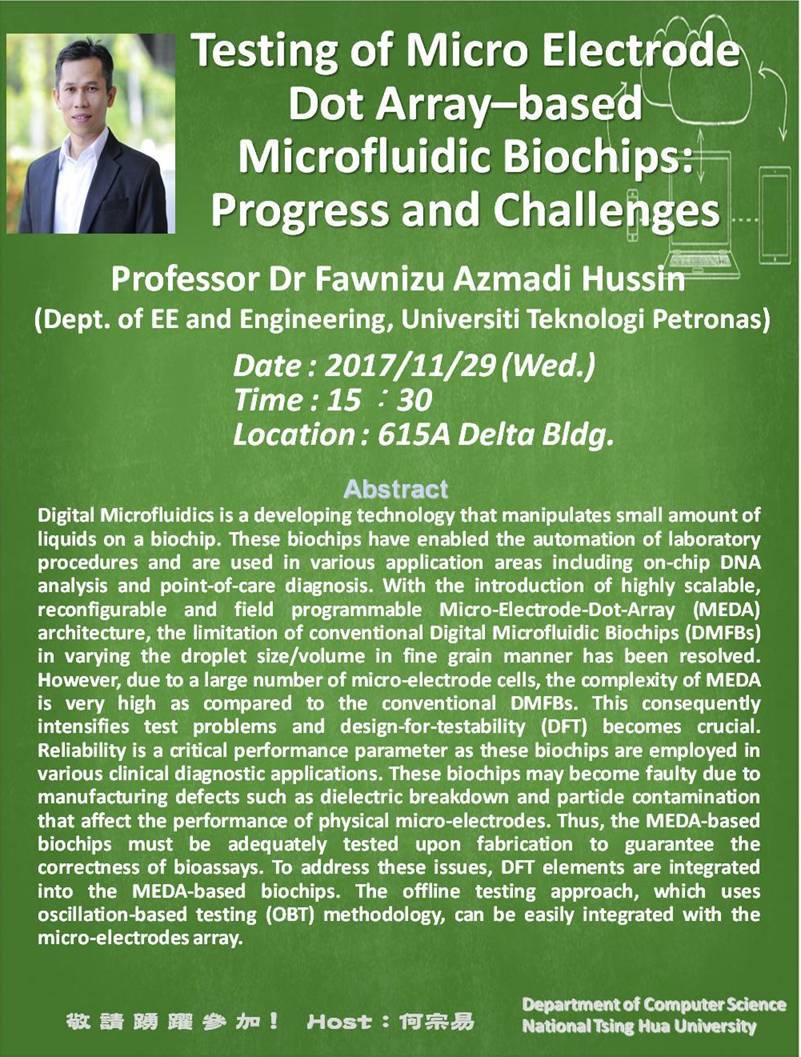
11/29(三)Testing of Micro Electrode Dot Array–based Microfluidic Biochips: Progress and Challenges
Speaker : Professor Dr Fawnizu Azmadi Hussin
(Dept. of EE and Engineering, Universiti Teknologi Petronas)
Date : 2017/11/29 (Wed.)
Time : 15:30
Location : 615A Delta Bldg.
Host : Prof. Tsung-Yi Ho
Abstract
Digital Microfluidics is a developing technology that manipulates small amount of liquids on a biochip. These biochips have enabled the automation of laboratory procedures and are used in various application areas including on-chip DNA analysis and point-of-care diagnosis. With the introduction of highly scalable, reconfigurable and field programmable Micro-Electrode-Dot-Array (MEDA) architecture, the limitation of conventional Digital Microfluidic Biochips (DMFBs) in varying the droplet size/volume in fine grain manner has been resolved. However, due to a large number of micro-electrode cells, the complexity of MEDA is very high as compared to the conventional DMFBs. This consequently intensifies test problems and design-for-testability (DFT) becomes crucial. Reliability is a critical performance parameter as these biochips are employed in various clinical diagnostic applications. These biochips may become faulty due to manufacturing defects such as dielectric breakdown and particle contamination that affect the performance of physical micro-electrodes. Thus, the MEDA-based biochips must be adequately tested upon fabrication to guarantee the correctness of bioassays. To address these issues, DFT elements are integrated into the MEDA-based biochips. The offline testing approach, which uses oscillation-based testing (OBT) methodology, can be easily integrated with the micro-electrodes array.