

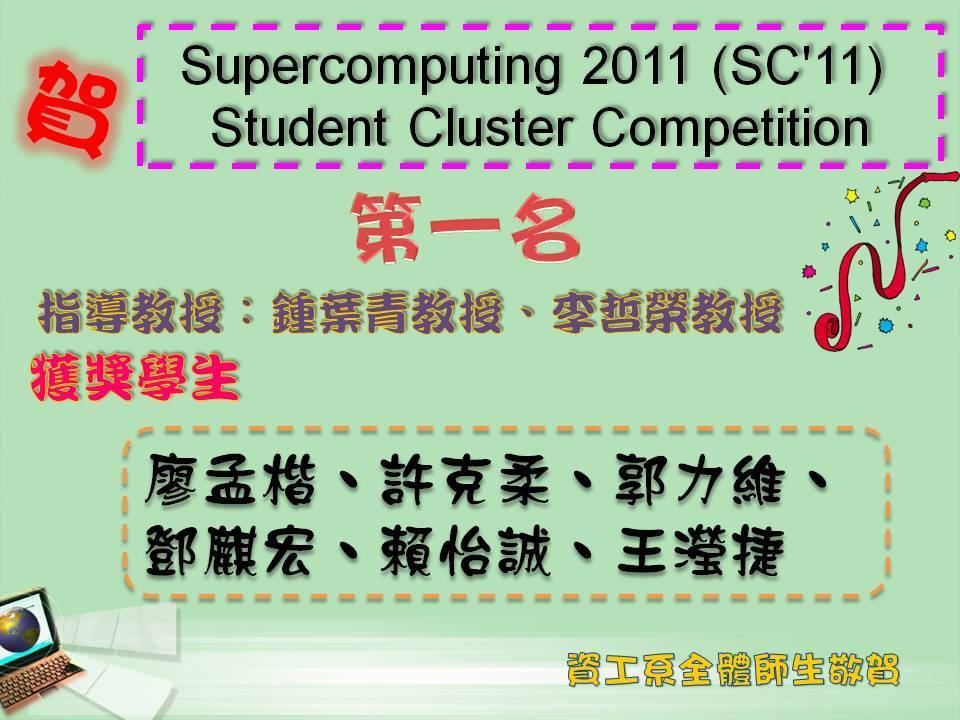
二連霸!!本系同學參加Supercomputing 2011 (SC'11) Student Cluster Competition比賽榮獲『第一名』(指導教授:鍾葉青教授、李哲榮教授)
Team profile:http://www.theregister.co.uk/2011/10/31/sc11_national_tsing_hua_university_taiwan/
SCC Final: Taiwan crowned champs
Ultra-close results, rise of GPUs
SC11 The final results of the 2011 Student Cluster Competition (SCC11) in Seattle are in the books and can be revealed. Well, they should have been revealed last night, but a series of meetings, bad hotel Wi-Fi, and perhaps alcohol played a role in the delay. In upcoming articles, you’ll see more videos and analysis of the results, but for now, let me sketch out the big picture.
In the closest finish, Team Taiwan from National Tsing Hua University took the overall student clustering crown for the second year in a row. They did it on a hybrid Acer system consisting of 72 Xeon CPU nodes and six NVIDIA Tesla C2070 GPU accelerators. On the memory side they had 48 GB/node, a bit low compared with other teams.
Barely behind Team Taiwan was NUDT’s Team China. The SC committee hasn’t (ever) released actual figures, but I was skulking around while they were being compiled and can say that the Taiwan-China scores were so close that hours of checking, re-checking, and then checking once again were required to make sure the results were correct.
Team China also rana hybrid CPU-GPU system. But the Chinese system, while sporting the same six NVIDIA C2070 Tesla accelerators as Team Taiwan, had only 24 Xeon cores. China had more memory per node at 96 GB each, but less overall memory at 192 GB total vs. 288 for Taiwan.
What’s obvious is that both of these teams did a great job of adapting the scientific workloads for use with GPUs. Some of the apps, like PFA, were already GPU compliant, but POP and some of the others were much less so and required some work to make them run efficiently. Both teams also did a great job of sandbagging me – always saying that they weren’t sure if their apps would take advantage of the GPUs, and that they weren’t expecting much.
Team Texas was a close third and had the highest score of any non-GPU competitor. Their mineral oil gambit seems to have paid off, giving them enough computing power (11 nodes, 132 Xeon cores and 48 GB per node) to both fit within the 26 amp limit and put up a good fight with the winners.
Team Boston, a new competitor, took fourth place with a massive hybrid AMD (336 cores)-NVIDIA (4xTesla M2090) system. This is a very good finish for a new team and also the highest placement of an AMD Interlagos-based box in the competition.
Just barely behind Boston was Team Russia with yet another hybrid system. Team Russia was sporting 84 Xeon cores and a whopping twelve NVIDIA M2070 cards while running a Microsoft operating system. While they didn’t take the overall crown, Team Russia nailed a win on LINPACK with their 1.9 TFlops result.
Close behind was Team Colorado, running a traditional CPU-based system with 256 Xeon cores and more memory (128GB per node) than any other team. Purdue’s gambit of sandbagging the Monday HPCC/LINPACK portion of the competition to apply maximum hardware to the scientific applications didn’t pay off as hoped. We have a video posted that discusses the what’s and why’s behind Purdue’s strategy.
Rounding out the competition was Team Costa Rica, who completed every challenge but didn’t excel in enough of them to put them above the leaders. They were thrown a last-minute curve ball when they had to change hardware vendors on setup day. The HPC Advisory Council – in the person of Gilad Shainer – stepped in to make sure that Costa Rica had everything they needed to compete. And compete they did, making a great impression on judges and spectators alike with their attitude, technical prowess, and desire to excel.
I’ll write a bit more analysis of the competition and what we’ve learned from it when I get back home – or maybe after the aspirin kicks in. But briefly, the huge impact of GPUs can’t be denied. Hybrids took the top two spots and four out of the top five places. The student teams were able to either find GPU-enabled codes for the scientific workloads or convert existing code to take advantage of them. That’s what made the difference this year. More later… meds now. ®(http://www.theregister.co.uk/2011/11/19/taiwan_2011_student_cluster_competition_winners/
世界高速電算賽 清大二連霸
台灣學生揚名國際再傳捷報。國立清華大學資訊工程系學生團隊今天在美國西雅圖舉行的世界級高速計算馬拉松學生叢集電腦計算競賽中,再度奪冠,創下二連霸紀錄。
清大今天接獲從美國傳來的好消息,由資工系教授鍾葉青、助理教授李哲榮帶領的學生團隊,參加在美國西雅圖舉行的「學生叢集電腦計算競賽」(StudentClusterCompetition,SCC),打敗來自世界各國的強勁對手,再度奪下第1名殊榮。
清大表示,這次奪冠學生團隊包括資工系大四的廖孟楷、許克柔、郭力維、鄧麒宏、賴怡誠以及大三的王瀅捷,其中,廖孟楷也曾參與去年在美國紐奧良舉行的賽事。
曾參與去年賽事的清大資工系主任金仲達接受中央社記者採訪表示,這項捷報於美國時間17日中午傳出,他今天一大早就收到資工系團隊從美國傳回的簡訊,大家都非常高興。
金仲達說,SCC是「國際高速計算會議」(SupercomputingConference,SCConference)從2007年起舉辦的學生競賽,今年是第5屆,前3屆冠軍都由歐、美團隊囊括,去年由清大資工奪冠,今年創下二連霸佳績。
金仲達說,這項比賽規定學生要在兩天時間內解出許多複雜題目,考驗參賽者耐力,而且比賽規定總耗電量有一定限度,所以不是解的快就好,更重要的是要有效率。
他說,由於題目相當複雜,透過「排程」有效率地解題,發揮團隊合作力量,有效分工,是致勝關鍵。為了這項比賽,學生們已集訓9個月至1年的時間。
清大表示,獲獎團隊師生仍在美國,預計台灣時間20日返台。
(轉載:中央社,記者黃彥瑜,2011-11-18)
新唐人電視台報導網址:http://ap.ntdtv.com/news/20111213/video/82835.html
比賽實況: