

Digital Microfluidic Biochips: Design Automation and Security Assessment
【演講訊息】12/07(一)10:00於台達館A614, Prof. Krishnendu Chakrabarty, Duke University, Digital Microfluidic Biochips: Design Automation and Security Assessment
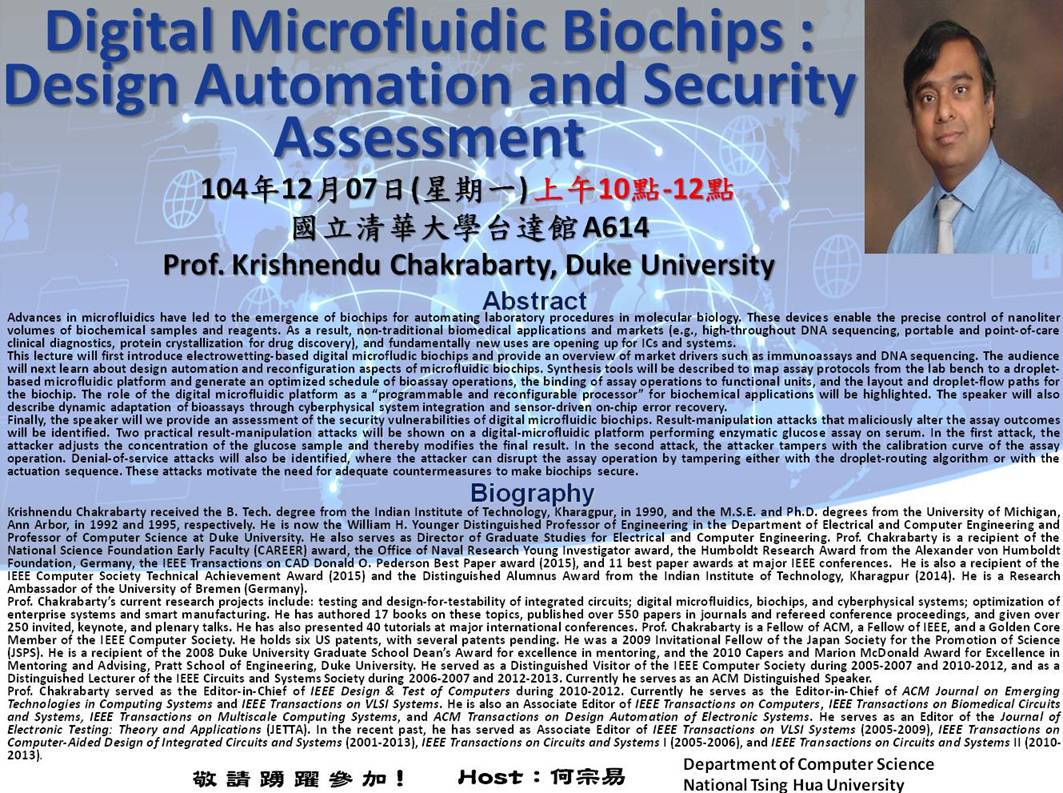
Title: Digital Microfluidic Biochips: Design Automation and Security
Assessment
SPEAKRT:Prof. Krishnendu Chakrabarty, Duke University
DATE:104年12月07日(星期一)上午十點
PLACE:台達館A614
HOST:何宗易老師
Abstract:
Advances in microfluidics have led to the emergence of biochips for
automating laboratory procedures in molecular biology. These devices enable
the precise control of nanoliter volumes of biochemical samples and
reagents. As a result, non-traditional biomedical applications and markets
(e.g., high-throughout DNA sequencing, portable and point-of-care clinical
diagnostics, protein crystallization for drug discovery), and fundamentally
new uses are opening up for ICs and systems.
This lecture will first introduce electrowetting-based digital microfludic
biochips and provide an overview of market drivers such as immunoassays and
DNA sequencing. The audience will next learn about design automation and
reconfiguration aspects of microfluidic biochips. Synthesis tools will be
described to map assay protocols from the lab bench to a droplet-based
microfluidic platform and generate an optimized schedule of bioassay
operations, the binding of assay operations to functional units, and the
layout and droplet-flow paths for the biochip. The role of the digital
microfluidic platform as a “programmable and reconfigurable processor” for
biochemical applications will be highlighted. The speaker will also describe
dynamic adaptation of bioassays through cyberphysical system integration and
sensor-driven on-chip error recovery.
Finally, the speaker will we provide an assessment of the security
vulnerabilities of digital microfluidic biochips. Result-manipulation
attacks that maliciously alter the assay outcomes will be identified. Two
practical result-manipulation attacks will be shown on a
digital-microfluidic platform performing enzymatic glucose assay on serum.
In the first attack, the attacker adjusts the concentration of the glucose
sample and thereby modifies the final result. In the second attack, the
attacker tampers with the calibration curve of the assay operation.
Denial-of-service attacks will also be identified, where the attacker can
disrupt the assay operation by tampering either with the droplet-routing
algorithm or with the actuation sequence. These attacks motivate the need
for adequate countermeasures to make biochips secure.
Speaker Bio:
Krishnendu Chakrabarty received the B. Tech. degree from the Indian
Institute of Technology, Kharagpur, in 1990, and the M.S.E. and Ph.D.
degrees from the University of Michigan, Ann Arbor, in 1992 and 1995,
respectively. He is now the William H. Younger Distinguished Professor of
Engineering in the Department of Electrical and Computer Engineering and
Professor of Computer Science at Duke University. He also serves as Director
of Graduate Studies for Electrical and Computer Engineering. Prof.
Chakrabarty is a recipient of the National Science Foundation Early Faculty
(CAREER) award, the Office of Naval Research Young Investigator award, the
Humboldt Research Award from the Alexander von Humboldt Foundation, Germany,
the IEEE Transactions on CAD Donald O. Pederson Best Paper award (2015), and
11 best paper awards at major IEEE conferences. He is also a recipient of
the IEEE Computer Society Technical Achievement Award (2015) and the
Distinguished Alumnus Award from the Indian Institute of Technology,
Kharagpur (2014). He is a Research Ambassador of the University of Bremen
(Germany).
Prof. Chakrabarty’s current research projects include: testing and
design-for-testability of integrated circuits; digital microfluidics,
biochips, and cyberphysical systems; optimization of enterprise systems and
smart manufacturing. He has authored 17 books on these topics, published
over 550 papers in journals and refereed conference proceedings, and given
over 250 invited, keynote, and plenary talks. He has also presented 40
tutorials at major international conferences. Prof. Chakrabarty is a Fellow
of ACM, a Fellow of IEEE, and a Golden Core Member of the IEEE Computer
Society. He holds six US patents, with several patents pending. He was a
2009 Invitational Fellow of the Japan Society for the Promotion of Science
(JSPS). He is a recipient of the 2008 Duke University Graduate School Dean’s
Award for excellence in mentoring, and the 2010 Capers and Marion McDonald
Award for Excellence in Mentoring and Advising, Pratt School of Engineering,
Duke University. He served as a Distinguished Visitor of the IEEE Computer
Society during 2005-2007 and 2010-2012, and as a Distinguished Lecturer of
the IEEE Circuits and Systems Society during 2006-2007 and 2012-2013.
Currently he serves as an ACM Distinguished Speaker.
Prof. Chakrabarty served as the Editor-in-Chief of IEEE Design & Test of
Computers during 2010-2012. Currently he serves as the Editor-in-Chief of
ACM Journal on Emerging Technologies in Computing Systems and IEEE
Transactions on VLSI Systems. He is also an Associate Editor of IEEE
Transactions on Computers, IEEE Transactions on Biomedical Circuits and
Systems, IEEE Transactions on Multiscale Computing Systems, and ACM
Transactions on Design Automation of Electronic Systems. He serves as an
Editor of the Journal of Electronic Testing: Theory and Applications
(JETTA). In the recent past, he has served as Associate Editor of IEEE
Transactions on VLSI Systems (2005-2009), IEEE Transactions on
Computer-Aided Design of Integrated Circuits and Systems (2001-2013), IEEE
Transactions on Circuits and Systems I (2005-2006), and IEEE Transactions on
Circuits and Systems II (2010-2013).